
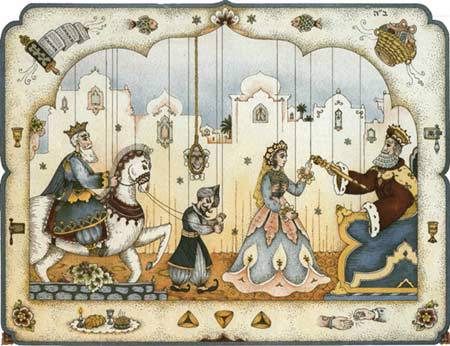
Purim means “lots” and refers to the lots that Haman cast in the book of Esther to determine the date for the destruction of the Jewish people who were in exile across the Babylonian Empire. Haman, an official in the Empire, convinced the King to issue an extermination order after Mordechai refused to bow down to him. Mordechai appealed to his cousin Esther who was the Queen for help, she instructed that every Jew fast and pray for her before she approached the King. Because of her bravery and intervention, the Jewish people were permitted to defend themselves and rather than being wiped out and they instead defeated all their enemies. This of course is a grossly abbreviated version of the story and one of the practices of the holiday of Purim is to read the “whole megillah” twice. A megillah is a scroll containing a book of scripture.
During the reading of the megillah of Esther everyone is given graggers, or noisemakers. At the name of Haman a deafening din is created to “drown out his name to “stomp him out” and when Mordechai is named everyone cheers. This is done on the evening before the 14 of Adar and again sometime during the day. (In the Jewish calendar a day starts and ends at sundown.)
A major theme of the book of Esther is concealment. The name of God isn’t mentioned at any point in the book, but his action is clearly present and there are many hidden literary illusions to God in the original Hebrew. For example, “Hidden in the Hebrew text of Esther 5:4, in the phrase “let the king and Haman come today” (Yavo HaMelech V’haman Hayom), the Tetragrammaton appears—the four letters that spell the personal name of the God of Israel.” Esther is also concealed as she hides her Jewish identity from the King until the very end of the story. This is why wearing costumes is one of the traditions that people of all ages participate in.
A traditional treat during the holiday is a cookie called a hamantaschen. The cookies are triangular with jam in the middle. They first are referenced as a tradition in a 16th century Italian Purim comedy skit. There they are called Oznei Haman, translated as “Hamans Ears,” and bear a resemblance to a European pastry called “little ears”. Hamantaschen can be translated as Haman pockets (tash), or poppy seed (mohn) pockets, poppy seeds are the original traditional filling for the pastry. The Talmud teaches that in order for Esther to not violate Kosher while her identity was a secret, she ate a diet that was the same as the one in Daneil 1:8-16 which consisted primarily of “pulse” – “foods made of seeds, grains, etc.” (Mosiah 9:9 (8–9); D&C 89:14.)
Purim is the celebration of the first time in Jewish history that the people as a whole chose God and being Jewish over assimilation, even when facing certain death for it. This is why it is one of the most joyful and exuberant celebrations in the entire calendar and is considered to be even more monumental than the moment when they initially accepted the covenant at Sinai.
Learn More
- Understanding Purim – my blog on the meaning and history of the tradition
- Why do Jews go Berserk on Purim?
- Purim Links
- More Purim stories of divine rescue
- 7 Best Movies to watch for Purim
Celebrating Purim
There are four mitzvot (“commandments” or “good works”) to be done on Purim:
- Read or hear the Megillah (Scroll of Esther) at night and by day.
- Give charity to at least two needy people.
- Send a minimum of two ready-to-eat foods to at least one person.
- Sit down for a royal feast.
Purim Videos on YouTube
Header Art: Purim, Elena Flerova, Judaica-Art.com


Leave a Reply