Right after my baptism I was asked if I would be comfortable giving a talk, I said sure no problem. Later when I got the call from the Bishop and was asked to speak on the role of the Holy Spirit my first thought was “oh geeze, what have I gotten myself into”! But I am up for the challenge!
A little bit of background about myself first though. I was raised evangelical, which is the predominant Christian tradition in this country, and left that while going through my divorce. I then attended a charismatic church for a couple years while also participating in a home study group where I learned about the Jewish context of the Old and New Testaments. I was at the that congregation only about two years before I determined that it was not the right place for me to be and I spent the last nearly 10 years at an Episcopal church. As a result, I have experienced some of the broad variety that is part of the Christian tradition, and they all engaged with the Holy Spirit and talked about the Holy Spirit in different ways.
So, when I started writing this talk it was very important for me to do the best I could to root it in both scripture and the wisdom of church doctrine and the elders.
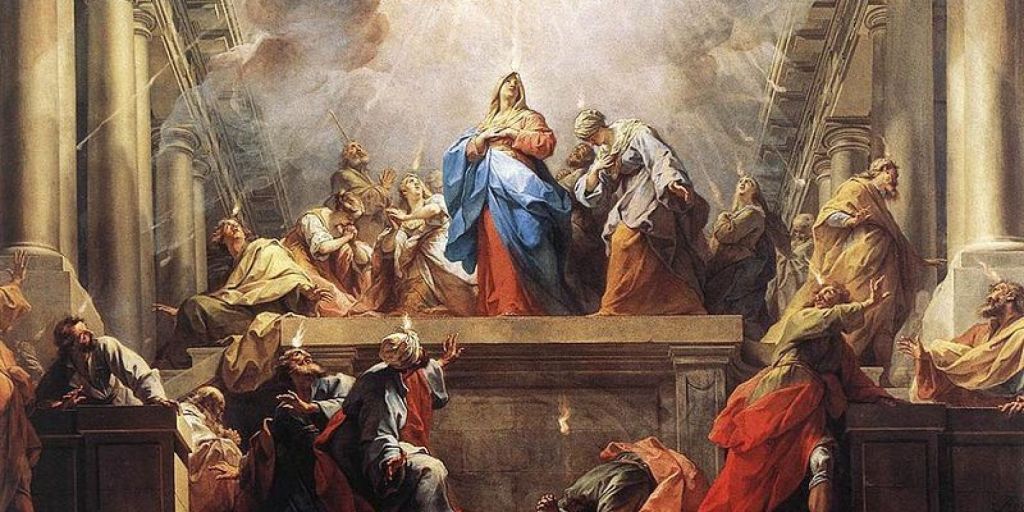
I found my initial inspiration in the fact that just earlier this month was the anniversary of Pentecost. Pentecost is a significant event in the history of the early church and is often called the birthdate of the early church. The reason it is considered the “birthdate” of the church is because this was the day that the Holy Spirit was poured out on the disciples after Christ’s ascension. It was the very first endowment of the Holy Spirit on all believers and didn’t occur until 50 days after Christ’s death and resurrection at Passover, and more than a week after he ascended.
This was a pivotal event and it is recorded in Acts 2. So my question was –
What can be learned about the role of the Holy Spirit from the story recorded in Acts and why did Heavenly Father wait until so long after Christ’s ascension to endow the Apostles with the Holy Spirit?
The account of Pentecost in Acts 2:1-12 reads:
1 And when the day of Pentecost was fully come, they were all with one accord in one place. 2 And suddenly there came a sound from heaven as of a rushing mighty wind, and it filled all the house where they were sitting. 3 And there appeared unto them cloven tongues like as of fire, and it sat upon each of them. 4 And they were all filled with the Holy Ghost, and began to speak with other tongues, as the Spirit gave them utterance. 5 And there were dwelling at Jerusalem Jews, devout men, out of every nation under heaven. 6 Now when this was noised abroad, the multitude came together, and were confounded, because that every man heard them speak in his own language. 7 And they were all amazed and marvelled, saying one to another, Behold, are not all these which speak Galilæans? 8 And how hear we every man in our own tongue, wherein we were born? 9 Parthians, and Medes, and Elamites, and the dwellers in Mesopotamia, and in Judæa, and Cappadocia, in Pontus, and Asia, 10 Phrygia, and Pamphylia, in Egypt, and in the parts of Libya about Cyrene, and strangers of Rome, Jews and proselytes, 11 Cretes and Arabians, we do hear them speak in our tongues the wonderful works of God. 12 And they were all amazed, and were in doubt, saying one to another, What meaneth this?
The question of the crowd “what meaneth this” is the question we are asking today.
To answer that question it is important right now for me to provide some background information. We read earlier this year the narrative of the exodus, Mount Sinai, the giving of the law, and the divine establishment of certain holidays. God commanded that Passover be celebrated every year with a feast and sacrifice of lambs so that the people would always remember how they were delivered from Egypt. Immediately following Passover was the feast of Unleavened Bread which started the countdown to the next holiday. So right after Passover, starting with the feast of Unleavened Bread, God commanded the people to count 7 weeks, or 49 days, and then celebrate the first fruits of the harvest. This first fruits feast was called Shavu’ot, or in Greek – Pentacost. The events of Act 2 where the Holy Spirit was poured out on Christ’s church occurred on the Jewish feast of Shavu’ot.
So this is our timeline; Christ died on Passover, the anniversary of Israel’s redemption from Egypt, was resurrected on the third day during the feast of Unleavened Bread and at the beginning of the countdown towards the feast of First Fruits. He ministered for 40 days, and then told the apostles to wait in Jerusalem for the comforter that would be sent to them before ascending into Heaven.
So they waited – they worshiped daily in the temple and waited over a week anticipating what might be coming next, knowing full well that Shavu’ot was just around the corner. Now Shavu’ot is one of three mandatory pilgrimages that God established at Mount Sinai, so as they waited Jerusalem began to fill with devout Jewish men from all the nations for the festival. Then on the day of the festival, as they were gathered together, the Holy Spirit was poured out and tongues of fire appeared above their heads as they spoke in languages they did not know previously. And the crowds that had gathered in Jerusalem from across the Roman Empire heard them speaking of the wonderful works of God in their native languages and were amazed.
So what is it about Pentecost that caused Heavenly Father to wait to pour out the Holy Spirit on the early Church and what does that mean for how we understand the role of the Holy Spirit?
A clue can be found in the timeline of the Exodus – traditionally within Judaism, both today and in the time of Christ, every spring festival was the anniversary of a significant event in the exodus from Egypt. Passover is a remembrance of the slaying of the Lambs in Egypt; the first day of Unleavened Bread is a remembrance of the flight from Egypt, and Pentecost is a remembrance of the giving of the Torah at Mount Sinai. So, the next question is, what happened at Mount Sinai and what does that have to do with the HS?
Exodus 19: 4, 5,9, & 16-19 reads:
4 Ye have seen what I did unto the Egyptians, and how I bare you on eagles’ wings, and brought you unto myself. 5 Now therefore, if ye will obey my voice indeed, and keep my covenant, then ye shall be a peculiar treasure unto me above all people: for all the earth is mine: 9 And the Lord said unto Moses, Lo, I come unto thee in a thick cloud, that the people may hear when I speak with thee, and believe thee forever. And Moses told the words of the people unto the Lord. 16 And it came to pass on the third day in the morning, that there were thunders and lightnings, and a thick cloud upon the mount, and the voice of the trumpet exceeding loud; so that all the people that was in the camp trembled. 17 And Moses brought forth the people out of the camp to meet with God; and they stood at the nether part of the mount. 18 And mount Sinai was altogether on a smoke, because the Lord descended upon it in fire: and the smoke thereof ascended as the smoke of a furnace, and the whole mount quaked greatly. 19 And when the voice of the trumpet sounded long, and waxed louder and louder, Moses spake, and God answered him by a voice.
This is a very exciting and dramatic story but according to very old Jewish tradition, one that the Apostles would have been familiar with, there was more to the story. The tradition stated that the giving of the Torah at Mount Sinai was accompanied by two additional wonders.
The first wonder being that as the Lord descended on the mountain in fire and smoke, flames of fire broke off and came to each individual at Sinai. Jewish author Moshe Weissman describes the tradition this way –
“On the occasion of the giving of the Torah, the Children of Israel not only heard the LORD’s Voice, but actually saw the sound waves as they emerged from the LORD’s mouth. They visualized them as a fiery substance. Each commandment that left the LORD’s mouth traveled around the entire camp and then came back to every Jew individually.”
The second wonder was that the voice of God at Mt Sinai spoke in every language known to man. A Jewish Midrash explains it this way:
“all the people witnessed the thunderings”. Note that it does not say “the thunder,” but “the thunderings”; wherefore Rabbi Johanan said that God’s voice, as it was uttered, split up into seventy voices, in seventy languages, so that all the nations should understand.”
The number 70 in Jewish numerology represents all the nations of the earth, so 70 languages means that God spoke in every language known to man simultaneously and every man there heard it in a language he understood.
So we see that at the time of the Apostles there was an unbreakable link between the festival of Shavu’ot and the miracle of the presence of God settling on the mountain of Sinai. Where he made a covenant with, and spoke the commandments to, each person there individually and tangibly – they heard it in every language, and they saw it as individual tongues of flame. Heavenly Father chose to pour out the Holy Spirit on this day and in such a way that there could be absolutely no doubt as to its meaning and significance.
Hundreds of years earlier this moment was prophesied of by Ezekiel and the prophet had this to say about the day that the spirit would be poured out:
Ezekiel 36: 26-27:
26 A anew heart also will I give you, and a new spirit will I put within you: and I will take away the stony heart out of your flesh, and I will give you an heart of flesh. 27 And I will put my spirit within you, and cause you to walk in my statutes, and ye shall keep my judgments, and do them.
Ezekiel directly connected the pouring out of the Spirit in the end days with covenant faithfulness, and by choosing Pentecost to pour out the Holy Spirit Heavenly Father confirmed it.
One of the teachings of the church that spoke to me of its truth was the emphasis on covenant making with Heavenly Father and the importance of keeping commandments for our spiritual progression. Elder Boyd K. Packer said in his April 1987 talk:
“Ordinances and covenants become our credentials for admission into His presence. To worthily receive them is the quest of a lifetime; to keep them thereafter is the challenge of mortality.”
This teaching is unique to this church. You will not find any other Christian denomination using such language, and for the evangelicals among which I was raised it would make them highly uncomfortable because so much of the message that they are taught as the gospel says that there is nothing we need do, save accept Christ as our savior. What an anemic and poverty-stricken gospel that does not call the believer into a higher way of living as a response to being saved. That is the entire narrative of the Exodus which prefigured Christ’s atonement and our current relationship with Heavenly Father. It is natural and good for the redeemed to respond to the redeemer with acceptance of a covenant relationship that binds them together the way a bride and groom are bound to each other.
I love this quote from Elder Bednars April 2022 talk:
“The cardinal direction for all of us in mortality is to come unto and be perfected in Christ. Holy covenants and ordinances help us to keep our focus upon the Savior and strive, with His grace, to become more like Him. Most assuredly, ‘an unseen [power] will aid me and you in the glorious cause of truth.’”
That “unseen power” is the Holy Spirit and the Holy Spirit has rigged the game in our favor so that we can receive the blessings of faithfulness to our covenants with God. This is the role of the Holy Spirit, to “cause you to walk in his statutes.”
So having seen how Heavenly Father orchestrated the events of Pentecost to connect us back to Mount Sinai and the call to covenant faithfulness the next question that came to my mind was what does that look like in practical terms? How does the HS aid us in the glorious cause of truth?
The church “Guide to the Scriptures” lists 4 vital roles that the Holy Spirit plays in the plan of salvation, and we can see these roles evidenced in the events of Mt Sinai and Pentecost.
- The Holy Spirit witnesses to us of Heavenly Father and Jesus Christ.
I understand this to be that the Holy Spirit makes God tangible so that we know who we are covenanting with and why and have a deep assurance that Heavenly Father and Jesus Christ are real. God manifested himself in a personal and tangible way at Mount Sinai – The people of Israel experienced him in a way that could not be explained away. At Pentecost the Holy Spirit was manifested in a similar way that was visible and personal to each person there and 3,000 were added to their number. It is important that we each have our own moments where God is made tangible to us. Because, as we read in the book of Judges last month, when the presence of God was no longer tangible the people of Israel forgot him. They struggled to keep to their covenants, and it was only a generation, if that, before they began to worship the gods of the nations around them and within 3 generations they were as wicked as Sodom and Gomorrah and “all the people did what was right in their own eyes”.
As I have been drawn down this path to joining the church I have been delighted and encouraged by the number of stories I have heard from members of the ways in which God has been made tangible to them – big ways and small ways, intimate and personal ways, each story unique to the individual and testifying of the reality of Heavenly Father and Jesus Christ.
- The Holy Spirit reveals the truth of all things.
The Holy Spirit brings to our remembrance the teachings and commandments of Christ. In John 14 Christ promises that for those who love him and keep his commandments they would receive the Comforter and Spirit of Truth. At Sinai the people knew the truth – there is only one God, and they received the commandments that would keep them close to that truth. At Pentecost the Apostles were inspired by the Spirit of Truth and preached from the scriptures, revealing truth in such a way that those who heard them received the light of that truth. The HS is our comforter and will remind us of the truths we have received and will remind you of what God has done for you.
- The Holy Spirit sanctifies those who have repented and become baptized.
At Mount Sinai the people had passed through the baptismal waters of the Red Sea and were sanctified to God. They were set apart the way a bride is set apart for her husband and covenants with him. Similarly, we are set apart at baptism, and like the Apostles who first received the Spirit, set apart to do good works and demonstrate a sanctified life before others.
Doctrine and Covenants 11:12 “And now, verily, verily, I say unto thee, put your trust in that Spirit which leadeth to do good—yea, to do justly, to walk humbly, to judge righteously; and this is my Spirit.”
- It is the Holy Spirit of Promise.
The Holy Spirit is the seal on the covenant and the promise of resurrection, of which Christ was the first fruit of the resurrected. At Shavu’ot the first bundles of grain were brought to the temple in anticipation of the rich harvest to come. We are part of the promised harvest of souls when we participate in ordinances and keep to our covenants. And also, as we assist others, even those who have gone before us, in theirs.
I will leave you with Doctrine and Covenants 76:50–53:
50 And again we bear record—for we saw and heard, and this is the testimony of the gospel of Christ concerning them who shall come forth in the resurrection of the just
51 They are they who received the testimony of Jesus, and believed on his name and were baptized after the manner of his burial, being buried in the water in his name, and this according to the commandment which he has given—
52 That by keeping the commandments they might be washed and cleansed from all their sins, and receive the Holy Spirit by the laying on of the hands of him who is ordained and sealed unto this power;
53 And who overcome by faith, and are sealed by the Holy Spirit of promise, which the Father sheds forth upon all those who are just and true.
I say these things in the name of Jesus Christ, amen.
Art: Pentecost, Jean Restout II, 1732

 Discovering the Saints
Leave a comment