This month the Christian community worldwide will be remembering and observing the events of Holy Week starting on March 24 with Palm Sunday and ending on March 31 with Easter. This month is also the anniversary of the dedication of the Kirtland Temple on March 27, 1836. Because the goal of my series this year is to draw connections between the Church established by Christ in the first century and the Church re-established by Christ in the 19th century, I thought I would examine what connections can be drawn between Holy Week and the services of the Temple. As I began to research it appeared initially that I had set myself an impossible task as there is very little that has been written modernly drawing a connection between the last week of Christ’s life and the temple building itself. Yet as I continued to read, I discovered compelling connections to atonement and the temple rituals of the Day of Atonement, Yom Kippur. Quite a bit has been written about the connections between Passover and Easter [1], for obvious reasons, but it is interesting that the Passover sacrifice does not atone for sin, atonement is made on Yom Kippur.
Yom Kippur was understood to have important messianic implications that is not often talked about in connection with the work of Christ in his final week but appears to have been explicitly understood in the first couple centuries of the church. “The service of this holy day was the only one in the [Holy Temple] that was fully and sequentially carried out by one specific individual: the [High Priest]” [2], just as the events of Holy Week would ultimately be carried out and accomplished by Christ alone who is our High Priest. Much of the research I use in this article regarding the symbolism of the Temple and Yom Kippur is taken from the work of Margaret Barker. “Over the course of the last twenty-five years, she (Margaret Barker) has argued that Christianity arose not as a strange aberration of the Judaism of Jesus’s time but rather as a legitimate heir of the theology and ordinances of Solomon’s Temple” [3]. Because there is simply too much material to cover, and perhaps I will write more on this topic at a later date, I will be focusing at this time on the underlying mythos of Yom Kippur, the rituals of the Jerusalem temple, and the Passion of Christ [4].
To understand Yom Kippur it is important to understand the function of the temple. One of the primary features of temples across time and place is their highly symbolic nature that was seen as a physical manifestation of heavenly realities. The temple at Jerusalem is unique however in that its design, furnishings, and the ceremonies performed in it, were given by revelation in great detail to a prophet who carried a priesthood mantle “in the similitude of the Only Begotten”; unlike other temples where man could only imitate what they remembered their fathers doing without having the understanding that comes from priesthood (Abraham 1:26, 27). Even with later changes made to the theology of the temple during and following the time of Lehi, the symbolism of the temple and its rituals endured and was the most perfect representation of the cosmos and God’s plan for man’s redemption available on earth. “In the words of Hugh Nibley. . . the temple is a ‘scale model . . . (of) the universe,’ a place for taking bearings on the cosmos and finding one’s place within it” [3]. In the symbolism of the Temple there are multiple levels of interpretation for how the temple is a “scale model”. In one view of the temple the various areas and implements reflected the creation of heaven and earth. The holy of holies was the creation of the heavens on day one – the realm of God and the angels, the veil was the creation of the firmament that divided the realms of heaven and earth on day two, and so on as you move through the temple to the outer court representing day six.
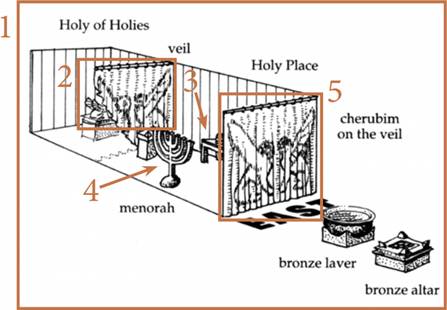
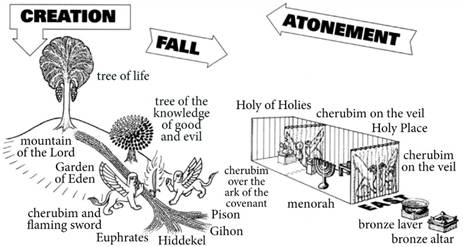
Alternatively, “The de’bir, the holy of holies, was the place of the LORD’s throne, but the hekal, the great hall of the temple, was the Garden of Eden” [5] making the outer court the region to which Adam and Eve were banished. “According to Mircea Eliade, who was a great Romanian scholar of comparative religions, the three parts of the temple at Jerusalem correspond to the three cosmic regions. The lower court represents the lower regions (“Sheol,” the abode of the dead), the holy place represents the earth, and the holy of holies represents heaven” [6]. Underlying all these interpretations is the emphasis on the temple being the physical manifestation of the point where the throne of God and all of creation converge. Yom Kippur was the only time that any human, in the form of the high priest, could make the journey into the holy of holies so “the course taken by the Israelite high priest through the temple can be seen as symbolizing the journey of the fall of Adam and Eve in reverse” [7].
In her work Margaret Barker attempts to reconstruct the beliefs of the first temple as it was before King Josiah’s reforms through careful reading of texts written by those who fled or protested the reforms. Some of the documents she uses are 1 Enoch, which was considered to be scripture by early Christians, the Damascus Document, the Ascension of Isaiah, Qumran Isaiah and Qumran Melchizedek [8], Hosea and Jeremiah, and for my purposes I will include 2 Nephi as well. It has been noted that “many of the themes that show up in 2 Nephi 6–10 have been identified as typical of the New Year and the Feast of Tabernacles on the regular Jewish calendar” [9]. In reading 2 Nephi 9 I also identified what appears to be themes of Yom Kippur as well. This would not be surprising since Rosh Hashana, Yom Kippur, and Sukkot all occur within a roughly 3 week span of time and are theologically connected with one another. The themes of the fall festivals revolve around judgement (Rosh Hashana), atonement (Yom Kippur), and redemption (Sukkot); we see these same themes in 2 Nephi 6-10 as well.
The underlying mythos of the fall festivals, as proposed by Margaret Barker in her reconstruction, set the stage for why judgement, atonement, and redemption are necessary and how it is to be affected at the cosmic level. Roughly outlined as I understand it, the story goes something like this:
At the beginning El Elyon and his consort Wisdom created the heavens and the Sons of God, they also created the earth and mankind to fill it. Wisdom wove into creation the Eternal/Cosmic Covenant, called the Covenant of Peace, and all of creation is held together by her net of the covenant. There were some among of the Sons of El Elyon, lead by the angel Asa’el, who lusted after the daughters of men and conspired together to transgress the laws of Heaven. They took for themselves wives from among the daughters of men and taught mankind things that were forbidden, like how to make war on one another. Thus was the Eternal Covenant of Peace broken, chaos released, and creation polluted. Responsibility for repairing the covenant fell to the firstborn among the Sons of God, the LORD (Jehovah). At the great Day of Judgement the LORD, who is also called Melchizedek the Great High Priest, will offer his own life and blood to repair Wisdom’s net, purify creation, and save the Sons of Light – the faithful among mankind, from the power of the Prince of Demons [5] [10] [11].
Due to the fragmentary nature of the texts from which this myth is complied it cannot be known for certain what the full original myth was. We know there is also a covenant with Adam that is referenced in Hosea 6:6-8 that was transgressed and we know from Moses 4 and Abraham 3 that there were other motivating factors for some of the Sons of God to rebel and that the initial rebellion happened before the creation of Adam. Whatever the original mythos was, it is not difficult to see elements of what was revealed to and taught by Joseph Smith, that was previously forgotten by the rest of Christianity or suppressed by Josiah’s reforms.

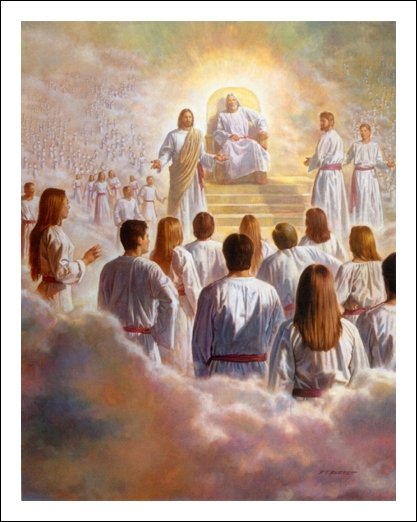
Robert T. Barrett, The Grand Council, 2001. The Book of Mormon Art Catalog, bookofmormonartcatalog.org
In this myth we can see that the purpose of the atonement was to restore the original Cosmic Covenant of Peace that had been transgressed by men and angels. The word atonement in Hebrew is “kippur” and is usually translated as “cover”, as in covering a sin to hide it from God, however it is also legitimately translated as “to repair a hole, cure a sickness, mend a rift, make good a torn or broken covering” [12]. When applied to the original Yom Kippur myth in this case it is repairing the “net” of the covenant that binds creation together and curing the sickness plaguing creation and the souls of men, e.g. Isaiah 2:5 “The earth lies polluted under its inhabitants for they have transgressed the laws, violated the statutes and broken the everlasting covenant” [5]. This is how the early Christians understood it – “thus Paul wrote of ‘the purpose set forth in Christ… to unite all things in him, things in heaven and things on earth’ (Eph. 1:10) and ‘through him to reconcile to himself all things, whether on earth or in heaven, making peace by the blood of his cross’” (Col. 1:20) [13].
So in understanding that the Temple is as a physical “type” of the entirety of creation and heaven the rituals that are performed in it must also be understood as a physical manifestation of a heavenly reality. “The rituals of the holy of holies were thus taking place outside time and matter, in the realm of the angels and the heavenly throne, and those who functioned in the holy of holies were more than human, being and seeing beyond time” [10]. In the services of Yom Kippur, the High Priest begins preparations a week in advance, since he will be the only one performing all of the rituals he must know them by heart. On Yom Kippur the High Priest will dress only in white without the usual richly ornamented vestments, he will ritually wash himself multiple times throughout the service, and will have two priests standing by who will assist in collecting the blood of the offerings – the first will take over the service in the event the High Priest is disqualified for some reason, the second is the head of the family responsible for supplying the priests for that week of service. Ten times in the course of the service the High Priest will also speak out loud the name of God (YHVH) that is never used outside of the temple and the assembled congregation would prostrate themselves and respond with “blessed be the Name of His glorious kingdom, for ever and ever” [2].
The order of the Yom Kippur service happens as follows [2]:
- The High Priest (HP) prays and confesses sin on behalf of himself and his family over the head of a bull.
- The HP then draws lots over two goats and holds the lots over their heads. One says “Azazel” and the other “HaShem”. The two goats are then marked with red cords to differentiate them.
- The bull is now dedicated to the sin of the entire Priesthood – “The Talmud explains that first the Kohen Gadol atones for his own sins and those of his family, and only afterwards does he make atonement for his colleagues…for it is better for an innocent man to make rectification for those who are liable.” The bull is then killed and the blood collected.
- The HP collects coals from the altar in the outer court and carries the coals and the incense offering into the holy of holies (HoH) and burns the incense before the ark/foundation stone and offers a prayer on behalf of all Israel before the altar of incense before exiting the temple. This is the moment of greatest tension as the congregation waits to see if the HP will successfully exit the HoH without being struck down by God.
- After the HP exits the temple and retrieves the blood of the bull he returns to the HoH. He sprinkles the blood on the ark/foundation stone. Before exiting the temple the vessel that still contains blood is placed on a special tray beside the veil and altar of incense.
- The HP returns outside and slaughters the goat marked for HaShem, he takes the blood into the HoH and follows the same procedure as the blood of the bull.
- Once outside the veil the HP sprinkles the blood of the bull, then the goat, on the veil before mixing them thoroughly and sprinkling the blood on the altar of incense. Any remaining blood is poured out at the base of the altar of incense.
- The HP returns outside and offers confession for the entire nation over the head of the remaining goat. The goat for Azazel is then taken 12 miles into the desert.
- The goat is harassed and harried along the way with people pulling at its hair and declaring “take our sins and go”.
- Booths are placed every mile to aid the warden of the goat to help him complete the long arduous journey, with the exception of the last 2 miles. Men from the booths would accompany the warden each mile.
- After arriving at a cliff, the crimson cloth tied to the goat is divided into two pieces and the goat is pushed off a cliff. The Warden then waits until dark to return to Jerusalem.
- After receiving confirmation from the desert of the fate of the scapegoat the HP then burns the bodies of the bull and the first goat outside the city. The service is completed, the HP removes his white garments, and the doors of the temple are shut.
As much as I would like to make a complete comparison of Yom Kippur rituals and the events of Holy Week, I will limit myself to the most significant elements that correlate to Gethsemane and Golgotha. In the service of Yom Kippur it was essential that the High Priest be acceptable to God in order to carry out the annual renewal of the Eternal Covenant because as “the temple was polluted by the sins committed elsewhere in the creation. . .the cleansing of the temple was the cleansing and reconsecration of the creation” [13]. The High Priest was in fact understood to take on the very identity of the LORD (YHVH) in the process [5]. “The high priest wore the name of the Lord on his forehead, inscribed on a golden plate (Ex. 28:36). Most translations say that he wore the words ‘Holy to the Lord,’ but Jesus’ contemporaries understood the Hebrew words differently. Aristeas, a visitor to Jerusalem in the first century before Christ, and Philo a few years later both record that the high priest simply wore the Name, the four Hebrew letters YHWH” [13]. Like the crowds in the temple who would prostrate themselves when the High Priest spoke the name of the LORD, the crowds that welcomed Christ into Jerusalem recognized his High Priesthood when they declared “Hosanna, (save us), blessed is he who comes in the name of the LORD”. Nephi likewise alluded to this high priestly role on Yom Kippur when he spoke about the importance of learning the name of the Lord and giving glory to God in his 2 Nephi 6-10 sermon. In addition to bearing the name of the LORD the high priest was understood to take on his very identity through the ritual of the bull and goat of HaShem. Origen, who had connections with Jewish scholars, reported in his writings that the two goats were understood as directly representing HaShem and Azazel. So when the High Priest, who was previously made pure by the blood of the bull, entered the Holy of Holies with the blood of the goat, he was entering as the LORD and bearing the blood of the LORD [13]. “But Christ being come an high priest of good things to come, by a greater and more perfect tabernacle, not made with hands, that is to say, not of this building; Neither by the blood of goats and calves, but by his own blood he entered in once into the holy place, having obtained eternal redemption for us” (Hebrews 9:11-12). So where do we see Christ passing through a garden like Eden to approach the throne of God with the incense of prayer, the blood of a pure priesthood, and his own blood to be poured out for sin? Gethsemane – “This sacred spot, like Eden where Adam dwelt, like Sinai from whence Jehovah gave his laws, like Calvary where the Son of God gave his life a ransom for many, this holy ground is where the Sinless Son of the Everlasting Father took upon himself the sins of all men on condition of repentance” [14].

Harry Anderson, The Crucifixion, The Church of Jesus Christ Gospel Art Collection
Yet the first “goat offered as the sin offering does not in fact take away the sin. Instead, this is somehow collected by the high priest, presumably as he performs the atonement rite, ‘carried’ and then transferred from the high priest on to the head of the Azazel goat” [5]. So we see that once the high priest finished the rituals within the holy of holies the Eternal Covenant had been restored and all of creation redeemed, but he was still bearing the sins of Israel, they had not yet been dealt with.
“The priests were enabled to ‘bear’ the guilt in two ways: ordinary priests ate the flesh of the sin offering whose blood had been used for kippur. They were then said to ‘bear’ the iniquity (Lev.10:17) . . . the high priest himself ‘bears’ the iniquity of gifts consecrated to the LORD and thus they become acceptable (Exod. 28:38), but to do so, the high priest has to wear on his forehead the sacred Name. This seems to suggest that when the high priest functioned as the LORD, he absorbed the impurities of others” [5]. The second phase of Yom Kippur was initiated when the high priest then transferred the sins of Israel to the goat Azazel. Now why was the second goat seen to be the fallen angel Azazel? There is an ancient school of Jewish mystical thought that originated in the century before Christ. One of the early prominent Rabbi’s associated with this movement is credited with intimate knowledge of secret temple traditions. “The school of R. Ishmael taught: Azazel because it obtains atonement for the affair of Uza and Aza`el (b.Yoma 67b). . .The affair of Asael and its consequences is the major theme of 1 Enoch. . . In the Enochic tradition, the sin of the fallen angels results in the breaking of the ‘cosmic’ covenant and the corruption of the earth” [5]. The inference then is that, as the leader in breaking the Eternal Covenant, Azazel was ultimately responsible for the sin that resulted; by placing the sins of Israel on the goat Azazel the LORD in the form of the high priest was returning sin and corruption to where it came from. The goat Azazel was then “handed over” to the warden who would take the goat out into the desert; the Mishnah reports “people pulled out the goat’s hair as it was led away (m.Yoma 6.4). In the Epistle of Barnabas 42 there is a quotation from an unknown source about the scapegoat: ‘Spit on it, all of you, thrust your goads into it, wreathe its head with scarlet wool and let it be driven into the desert’” [5]. Along the way were stationed men who would walk with the warden to make sure he didn’t falter or fail to reach the final destination, once reaching the cliff the scarlet thread tied to the scapegoat would be divided and the goat flung off the cliff so that it could not return to Jerusalem. From Gethsemane Christ was “handed over” to wardens who would take him out of Jerusalem, and he would be tormented by the soldiers and harassed by the crowds but was also assisted along his way by others like Simon of Cyrene. Once outside of the city he was crucified, his garments divided, and his soul descended into the pit, carrying the sin and corruption of creation with him back to the Prince of Demons who orchestrated the breaking of the covenant, and he would minister to the souls in captivity there.
The atonement then is a function of two goats, one for the LORD and one for Azazel. According to the Mishnah “they had to be identical (m.Yoma 6.1). Between them, they carried the ritual. This is important; the two goats were two aspects of one ritual and cannot be separated. This was known to the first Christians who had no difficulty in comparing Jesus to both goats; he was both the sacrifice and the scapegoat” [5]. Yet there is one significant difference between Christ and the two goats, and this difference is key to why the atonement affected by the Heavenly Prince Jehovah is an eternal atonement, whereas the ritual with the goats needed to be repeated from year to year. This difference is also key to why the Melchizedek priesthood is eternal. We know the Melchizedek Priesthood is the order patterned after the priesthood given to the pre-mortal Christ (JST, Genesis 14: 27-28) and it was named Melchizedek after that righteous man so that the name of YHVH would not be uttered too frequently (D&C 107:2-4); which is the pattern we see in the temple with the name of YHVH only being spoken out loud during Yom Kippur. In JST, Genesis 14:32 we learn that the order of Melchizedek is not inherited but granted by God to one who is righteous, and that all holders of that priesthood were translated – so they never died but were transformed into their perfected bodies. This immortality is the major hallmark of the Melchizedek priesthood that makes it different from the Aaronic priesthood. Just as the Aaronic high priest was understood to take on the identity of the LORD by wearing the sacred Name and bearing the blood of the offering into the holy of holies, he was also understood to take on the mantle of the Melchizedek priesthood which also would have been necessary for affecting the annual atonement of creation. According to the Melchizedek Text, Melchizedek was prophetically understood to be the redeemer who would appear sometime between the years 19 and 25 C.E. and “would proclaim the liberty of the Jubilee year, rescue his own people from the power of the Evil One, and restore them to their rightful inheritance. The Anointed One would appear, and the kingdom of God would begin” [13] [15]. The manner in which this transference of identity occurred was brought about through the “re-birth” of the high priest when he successfully brought the blood of the LORD into the Holy of Holies and exited again without being struck down. “This ‘birth’ in the holy of holies changed the human into an angel and gave him great Wisdom. The last words of David describe him (the high priest/Melchizedek) as one through whom the Spirit of the LORD has spoken, a man who was anointed and raised up. . . a word that could also be translated ‘resurrected’ (2 Sam. 23:1). This is how it seems to have been understood at the end of the second temple period, because the Letter to the Hebrews contrasts the Levitical priests and Melchizedek: the former have their position due to descent from Levi, but Melchizedek has been raised up with the power of indestructible life (Heb. 7:15-16)” [10]. In Hebrews 5:6-10 and 7:19-20 we read that it was by Christ’s obedience to the will of God the Father that he was made “perfect”, this is the blood of the bull, and so he brought his own blood, the goat, into the presence of the Father and passed through the “veil” between our world and the throne of God; successfully leaving the “temple” of heaven in his resurrection and was made the Melchizedek High Priest forever. Because, unlike the goats, Christ offered his life and blood before the throne in heaven, yet still lives, that offering remains permanently before God as the atonement that has repaired the net holding creation together. And because we have a Melchizedek High Priest who lives, those who are re-born through baptism into the family of Christ can become partakers in the Melchizedek priesthood through ordination (JST, Hebrews 7:3). Just as the Levites were priests in the order of Aaron, yet there was only one Aaronic High Priest.
Understanding the atonement through the pattern provided by Yom Kippur brings so much clarity to how the atonement works that is not evident when we look at Passover alone. The early church in the first couple of centuries understood how the temple rituals witnessed of Christ but once the temple was gone and all things Jewish were jettisoned from Christian worship and ritual there was a great deal of knowledge that was lost. Plain and precious truths that were simply forgotten and, in some cases, intentionally erased. “Once a year on Yom Kippur, the Day of Atonement, Adam’s eastward expulsion from the Garden is reversed when the High Priest travels west past the consuming fire of sacrifice and the purifying water of the laver, through the veil woven with images of cherubim. Thus, he returns to the original point of creation, where he pours out the atoning blood of the sacrifice, reestablishing the covenant relationship with God” [3]. And once for all eternity Christ reversed the rift torn in the net of creation itself by the sacrifice of his perfect obedience, the purifying waters of baptism, through the veil of death dividing heaven and earth, returning sin and corruption to the Prince of Demons. He entered to the throne room of Heaven and stood before those Heavenly Parents and offered his own life to forever hold together the Eternal Covenant, bringing us back into perfect covenant relationship with God.
How delightful it is to study the scriptures, to discover the things kept hidden and forgotten, to demonstrate to others the purposes of the eternal patterns of the temple, the purpose of the laws of Moses, all things that were established from the beginning to reveal the Son of God to man. How beautiful are the covenants! Covenants of peace, of wholeness, of restoration, of grace and justice. Covenants of life eternal for creation and the Sons of Light. (My paraphrase of 2 Nephi 11:4-5)
References:
- For comprehensive coverage of Passover at the time of Christ, its Easter connections, and recommendations for family observance, I recommend Greater Love Hath No Man by Eric D. Huntsman.
- https://templeinstitute.org/yom-kippur/
- https://journal.interpreterfoundation.org/the-book-of-moses-as-a-temple-text/
- For an introduction to Yom Kippur symbolism in modern temples I recommend LDS Perspectives Podcast, Episode 94: Day of Atonement Symbolism in LDS Ritual with Shon Hopkin.
- Atonement: The Rite of Healing, Margaret Barker, 1994, MargaretBarker.com/papers
- https://www.fairlatterdaysaints.org/conference/august-2009/the-temple-as-a-place-of-ascent-to-god
- https://interpreterfoundation.org/knowhy-ot03a-what-can-the-architecture-of-israelite-temples-teach-us-about-creation-and-the-garden-of-eden/
- The Ascension of Isaiah and 1 Enoch are available on ScriptureNotes.com
- Welch, John W.. “2 Nephi 6-10.” In John W. Welch Notes, 165-177. Springville, UT: Book of Mormon Central, 2020
- The Temple Roots of the Liturgy, Margaret Barker, 2000, MargaretBarker.com/papers
- The Temple and the Covenant of Peace, Rome: American University 2019, Dr Margaret Barker, MargaretBarker.com/papers
- M. Douglas ‘Atonement in Leviticus’ Jewish Studies Quarterly 1(1993-94) p.117
- Barker, Margaret (2003) “The Great High Priest,” BYU Studies Quarterly: Vol. 42: Iss. 3, Article 3.
- The Purifying Power of Gethsemane, Elder Bruce R. McConkie, General Conference April 1985
- “Jesus in the synagogue at Nazareth. . . chose to read from Isaiah 61, the very text that was associated with Melchizedek coming to bring the good news of the Kingdom of God. “Today,” said Jesus, “this scripture has been fulfilled in your hearing” (Luke 4:21) – Barker, Margaret (2003) “The Great High Priest”

 Discovering the Saints
Leave a comment