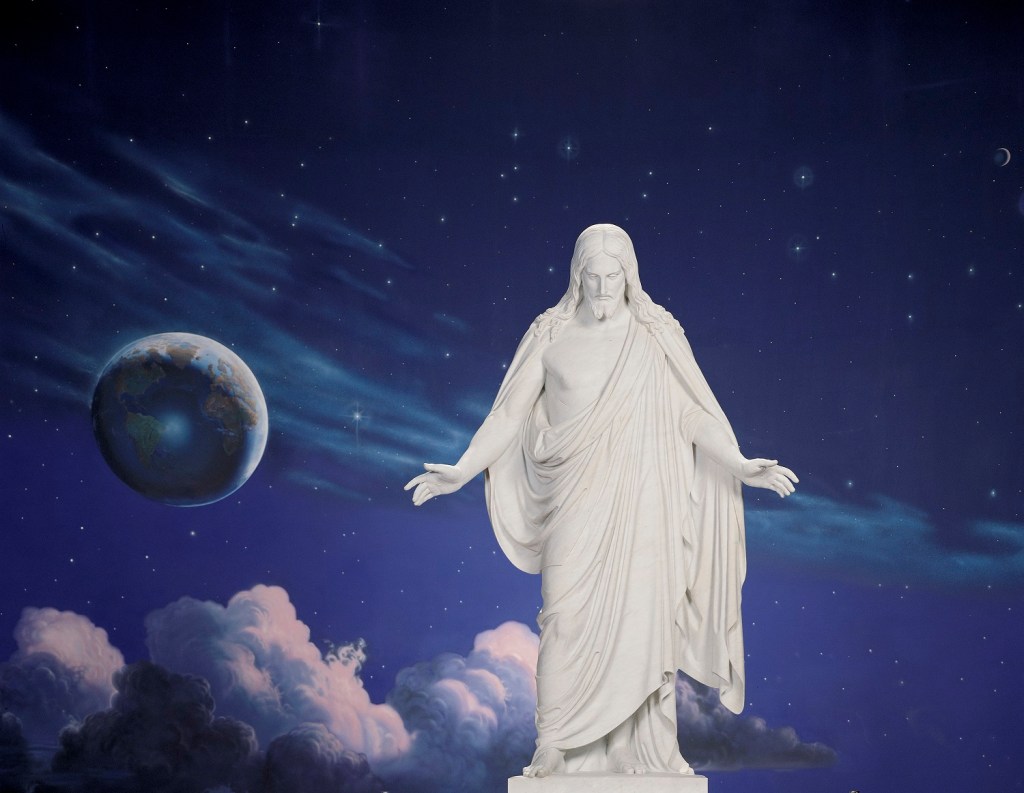
There are 3 conference talks (from April 2024 General Conference) that referenced Holy Week along with the call from the presidency to “remember” and be as intentional about how we observe Easter as we are about Christmas. I have been practicing Holy Week and other Christian traditions to some extent in my own household for about 10 years now, but for my husband it was a completely new experience that he didn’t always understand. My favorite talk was “The Greatest Easter Story Ever Told” because when my husband listened to it he quipped “well, I guess I can’t stop you now”.
I was first introduced to the idea of Holy Week and the larger Christian calendar of holidays when I was at the Episcopal Church. I fell in love with the concept of Holy Time and practicing traditions that bring that holiness into the home and as a spiritual discipline.
Holy Space we are familiar with, it’s the Temple. It’s special, set apart, and different from the world outside it. It’s a space that invites us to pause from our mundane and routine lives and spend time in heaven focusing on heavenly things. But it’s not a space that we can take with us.
Holy Time is something we can take with us anywhere and create pockets of temple like holiness, beauty, and sanctity within our home or wherever we are by pausing and “remembering” through traditions and rituals that are different from our normal behaviors.
My time in a traditional Christian church taught me what sacred time looks like and how to begin to incorporate it into my own life and home. I want my children to feel like they are somewhere familiar when they go to the temple because we have already been practicing bringing the holiness and peace of the temple into our home through intentional acts of remembering.
“To Dance with God” by Gertrud Mueller Nelson relates the traditions of the Christian calendar to poetry that speaks directly to the heart through rite and symbol, by acknowledging the cycles and seasons that the world goes through, and we go through as humans. It also connects us to our ancestors, many of whom worshiped in this exact way.
I love this quote from the book “This creative and poetic church helps us to pay full attention to what we might otherwise deem ordinary and commonplace. Rites and symbols use the ordinary and earthly elements of our existence and, by encircling them, ratify, sanctify, and complete. The ordinary becomes the container for the divine -” This is what the Temple does for us with space. In his April 1993 talk President Howard W. Hunter uses Holy Week as an invitation to think more deeply about “if thoughts of Jesus, which “with sweetness [fill our] breast,” ought not to be far more frequent and much more constant in all times and seasons of our lives.”
Liturgy and the early church:
So, what could it look like to sanctify the times and seasons of our lives? I understand there may be some hesitancy among members of the church when it comes to anything that appears “Catholic”. This is the restoration after all.
Let’s look at where did these traditions come from –
The foundational elements of the Christian calendar developed with the very early church – most people didn’t have the ability to read or access to scriptures. Traditions became ways of remembering and experiencing scripture as part of a community and we can see elements of the Jewish calendar and traditions that were incorporated and adapted over time as well.
Gathering on Sunday, or the Lord’s Day, was one of the first practices to develop, and forms the backbone of the Christian calendar. It’s referenced as being observed in some aspect in New Testament passages like Acts 20 and 1 Cor 16, and in other very early church writings like the Didache, a compilation of regulations and rules for church life written in the first century (possibly by the disciples of the apostles themselves), and in the writings of Ignatius of Antioch, a bishop whom there is reason to believe was discipled by one or more of the original Apostles.
Easter is connected with Passover and the spring Jewish holidays which are Passover, First Fruits, and the Feast of Weeks. Obviously, Christ died on Passover, was resurrected during First Fruits, then the Holy Spirit came during the Feast of Weeks, or as it is translated in the New Testament, Pentecost. There is an incredible amount of prophetic and doctrinal significance to the fact that these important events occurred on holidays the Jewish people were commanded by God to keep. Christians developed their own traditions in order to continue to observe Easter with Pentecost as the culmination of the Easter season. It wasn’t until the council of Nicaea in 325 where Easter and Pentecost were formally separated from the Jewish festivals when the council declared that “all the fellow Christians in the east who have until now followed the Jewish practice will from now on observe the custom of the Romans”. Holy Week itself was formalized sometime shortly after the council of Nicaea.
The Christmas cycle has two high points: Christmas (25 December) and Epiphany (6 January). Of which the older of the two is actually Epiphany. Epiphany was observed beginning sometime before the second century as the anniversary of Christ’s baptism or of the arrival of the Magi in Bethlehem. Today it is the remembrance of the Magi (i.e. the first gentiles to worship Christ) and Christ’s baptism is given its own day of remembrance on January 8. Christmas itself originated in Rome around 350. Why was the 25 of December chosen? Because it is 9 months after the 25 of March which was believed to have been when Christ was conceived. A very old tradition in Christianity and Judaism is that a righteous person will die on the same day they were created. So, someone in the 4th century did some math and that’s what we ended up with. (LDS scholar Dan Mclellen goes into more depth on why December 25 was chosen in his videos). Advent (which is one of my favorite traditions) is a 4-week season of preparation for Christmas that was introduced in the 4th or 5th centuries. So, of all the holidays Christmas is actually the most “catholic”.
I would like to briefly mention the Jewish fall holidays which currently do not have any Christian corollary, but I believe they are of special significance for Latter Day Saints. These are Rosh Hashana (the Feast of Trumpets), Yom Kippur (The Day of Atonement) and the Feast of Tabernacles. There is an incredible amount of symbolism and prophetic significance packed into these holidays. I hope to tease your curiosity by sharing that Joseph Smith received the golden plates on the day of Rosh Hashana, began translating them on Yom Kippur, and thereby ushered in the last age which will end when Christ returns to Tabernacle with us in the Millenium.
Adapting it to the restoration:
I hope you’re more curious and excited now about what participating in traditional Christian holidays could mean for you as a way to bring awareness of Christ into all times and seasons of your homelife. Setting apart pockets of time to transform the mundane into something heavenly.
What could this look like for you?
Fortunately, there is a wealth of resources available if you don’t want to reinvent the wheel and would like to explore observing these holidays the way our ancestors did. There are books like the ones I brought and there are even LDS resources that are now being written which are currently on my wish list. Eric D. Huntsman has written books specifically for LDS families on observing the Christmas and Easter seasons. (See the page Additional Reading)
You can also create your own traditions for your family based on your capacity, interest, or even to coincide with the focus of Come Follow Me for that year. Examples are:
- Traditional holidays: Easter, Pentecost, Advent, Christmas
- Old Testament Holidays and their prophetic fulfillment
- There are specific days called Saint Days that focus on the lives of people who gave us the church we have today: 12 Apostles and other significant saints, martyrdom of Joseph and Hyrum Smith, Church Presidents
- Moments in history where God showed up: significant restoration events
Or create your own traditions, incorporate as many of the following 5 sensory elements as you can:
- Sight – colors, symbols, images
- Action – kneeling, breathing, meditate on scripture
- Speech – prayers, reading scripture aloud
- Smell – candles, incense
- Hear – music, silence
- Touch – prayer objects/aids, crafts
- Taste – special foods, sacrament
- *Smell and taste are the two senses that are most strongly connected to memory
Ultimately for me, the call from our church presidency to be more intentional about how we remember Christ on Easter was a reassurance that there is a place in the restoration for the traditions I had come to love. And it was also a challenge to not get complacent but to be intentional each year with how I choose to spend my time and how I raise my children with a tangible awareness at home of the work of Christ and the wonder of the Restoration.

 Discovering the Saints
Leave a comment