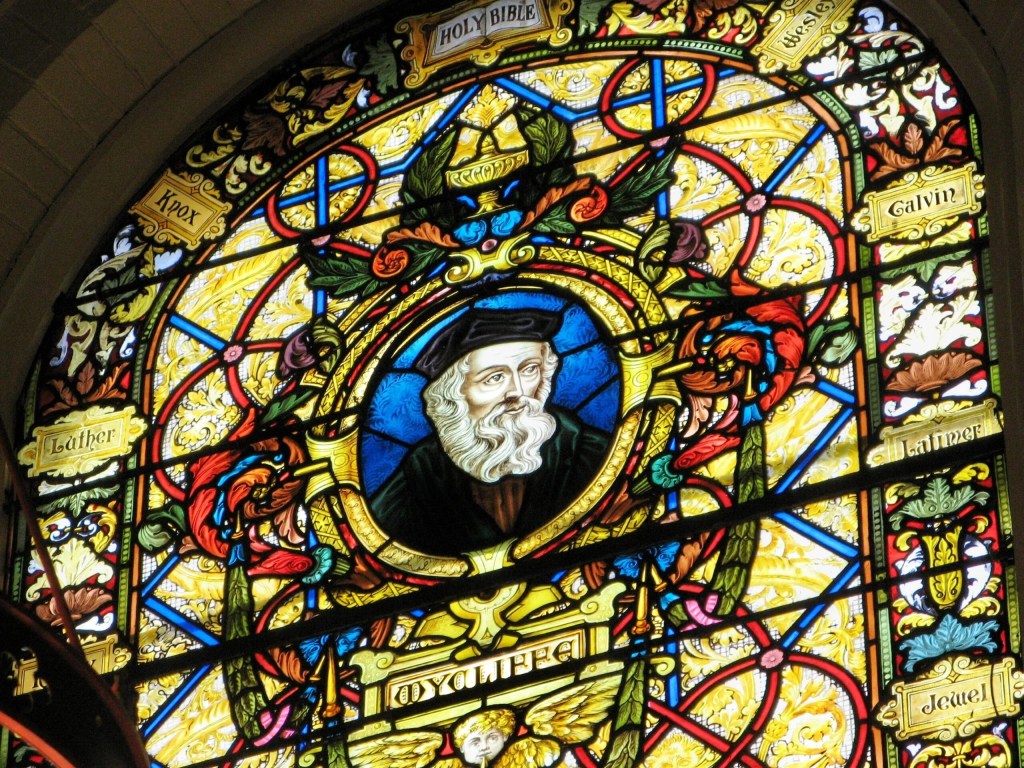

Born 1330 Yorkshire England Wycliffe received his formal education at Oxford where he also was appointed master of the Balliol College in 1360. A year later he left that position to become the vicar of the college’s church. He went on to become a Bachelor of Divinity in 1369 and Doctor of Divinity in 1372.
In 1374 King Edward III appointed Wycliffe to the rectory of Lutterworth as well as commissioned him to represent the state to the papal authorities in Rome regarding land rights and taxes owed to the church. Wycliffe advocated for a church that was disendowed of its substantial earthly wealth and encouraged the King to hold back funds. He also criticized longstanding policies of the church, such as the right of sanctuary and the doctrine of the church’s authority to bind and loose on earth. This put him at odds with his leadership and he was called to a disciplinary council in 1377 that ultimately did not result in any action being taken against him.
Starting in August 1380 Wycliffe began the project for which he is best known – translating the Latin Bible into Middle English. Before Wycliffe’s translation the entirety of the Bible had not been available in English. After its publishing the general person could understand what was being said when they heard the scriptures read out loud. In 1831 the Archbishop of Canterbury was murdered in the Peasants Revolt and his successor moved to discipline Wycliffe for his political and theological positions, which resulted in Wycliffe losing his long-held position of honor at Oxford and the banning of all his work.
Wycliffe died in December 1384. Wycliffe was recognized by later Reformers as a fore-runner to their efforts. He wrote about and argued for beliefs that would become hallmarks of Protestantism like Sola Scriptura, the greater power and authority of the laity over church hierarchy, and the symbolic rather than literal nature of the body of Christ in the sacrament. He was condemned as a heretic after his death and in 1428 his body was exhumed, burned, and the ashes thrown into a river.


 Discovering the Saints
Leave a comment