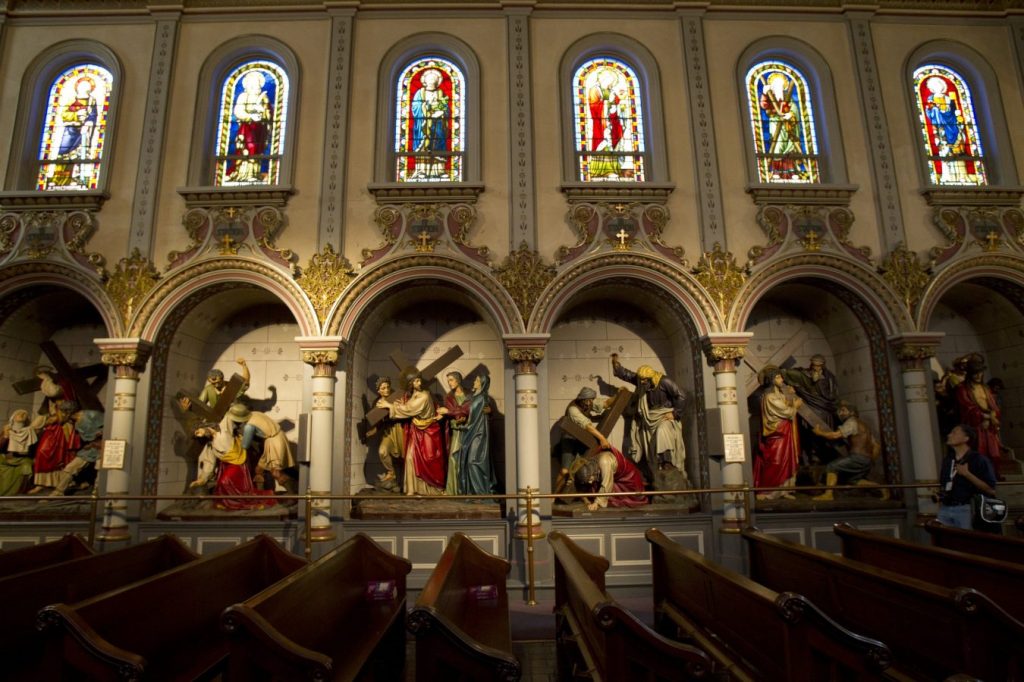
Also called the “Way of the Cross” or the “Via Dolorosa” in Jerusalem, the stations are moments in Christ’s final day as he makes his way from Pilot’s home to the tomb. In Jerusalem these are physical locations on a path that pilgrims will walk en masse on Good Friday. Outside of the Holy Land each station on the path is represented by some kind of artistic representation, often paintings or tableaux, and accompanied by a prayer and devotional. The stations will be set up along the interior walls of a church for visitors to walk through during Holy Week and there are many devotionals that have been created for home use as well.
The stations are rooted in the interest pilgrims had in visiting and worshiping in the places where Christ ministered and died. Christians have been making pilgrimage to sites in the Holy Land since as early as the 4th century. The earliest version the stations may originate with the monastery of San Stephano in Bologna where a series of connected chapels recreated popular pilgrimage sites in Jerusalem. The stations as they appear now date to the 15th century.
There are 14 stations, 8 come from scripture and 6 from tradition. The Anglican church offers a form of the stations where the 6 from tradition may be omitted if one chooses. There is an alternate series of 11 stations that was created in 1799 for the diocese of Vienne, Austria that may resonate more with Latter-day Saints. The goal of the stations is to walk those final moments with Christ as if we were actually there. To witness his suffering and empathize with the fear and suffering of his mother and the disciples.
Traditional Stations of the Cross
1. Christ condemned to death
2. The cross is laid upon him
3. His first fall
4. He meets His Blessed Mother
5. Simon of Cyrene is made to bear the cross
6. Christ’s face is wiped by Veronica
7. His second fall
8. He meets the women of Jerusalem
9. His third fall
10. He is stripped of His garments
11. His crucifixion
12. His death on the cross
13. His body is taken down from the cross
14. He is laid in the tomb
1799 Vienne Stations of the Cross
1. The agony in the Garden
2. The betrayal by Judas
3. The scourging
4. The crowning with thorns
5. Christ condemned to death
6. He meets Simon of Cyrene
7. The women of Jerusalem
8. He tastes the gall
9. He is nailed to the Cross
10. His death on the Cross
11. His body is taken down from the Cross
Utilizing the stations as a devotional is fairly simple. There are many guided devotionals that have been created, such as the Method of St. Francis of Assisi, Stations of the Cross at the Smithsonian American Art Museum, or these Stations of the Cross Cards for home and family use.
The use of art is an essential element of the stations as it engages the imagination and helps us to immerse ourselves in each moment the station represents as a form of mental pilgrimage. Scripture reading, meditating on the things Christ suffered, and repentance are also important elements in the stations. Though there are resources for observing the stations at home they are intended to be a communal experience we have with other members of the body of Christ. Where we remember that he suffered and died for us and that when he returns it will be to redeem all of creation. Just as eternity is spent as part of a family and is not a solo experience, our spiritual lives here on earth are also better when we practice our devotion to Christ as part of a community that is united in heart and spirit.
Catholic
Protestant
Art: Life-size Stations of the Cross at St. Anthony’s Chapel on Troy Hill in Pittsburgh in 2011. (Catholic News Service/Nancy Wiechec)

 Discovering the Saints
Leave a comment